
Surprising claim: a browser wallet that simulates every transaction before you sign it can reduce a large class of losses more effectively than a hardware wallet alone. That counterintuitive idea—software analysis catching attack-pattern logic that physical key-storage cannot—lies at the heart of Rabby’s browser extension and explains why serious DeFi users should pay attention.
This piece unpacks the mechanisms behind the Rabby Chrome extension (the Chromium-browser build is functionally identical across Chrome, Brave, and Edge), explains where its protections work and where they don’t, and presents concrete heuristics for deciding when to rely on Rabby versus layering other protections like hardware wallets or multisig. The focus is practical: how the extension changes the signing decision, what risks remain, and how to use the tool in a U.S. regulatory and threat environment.
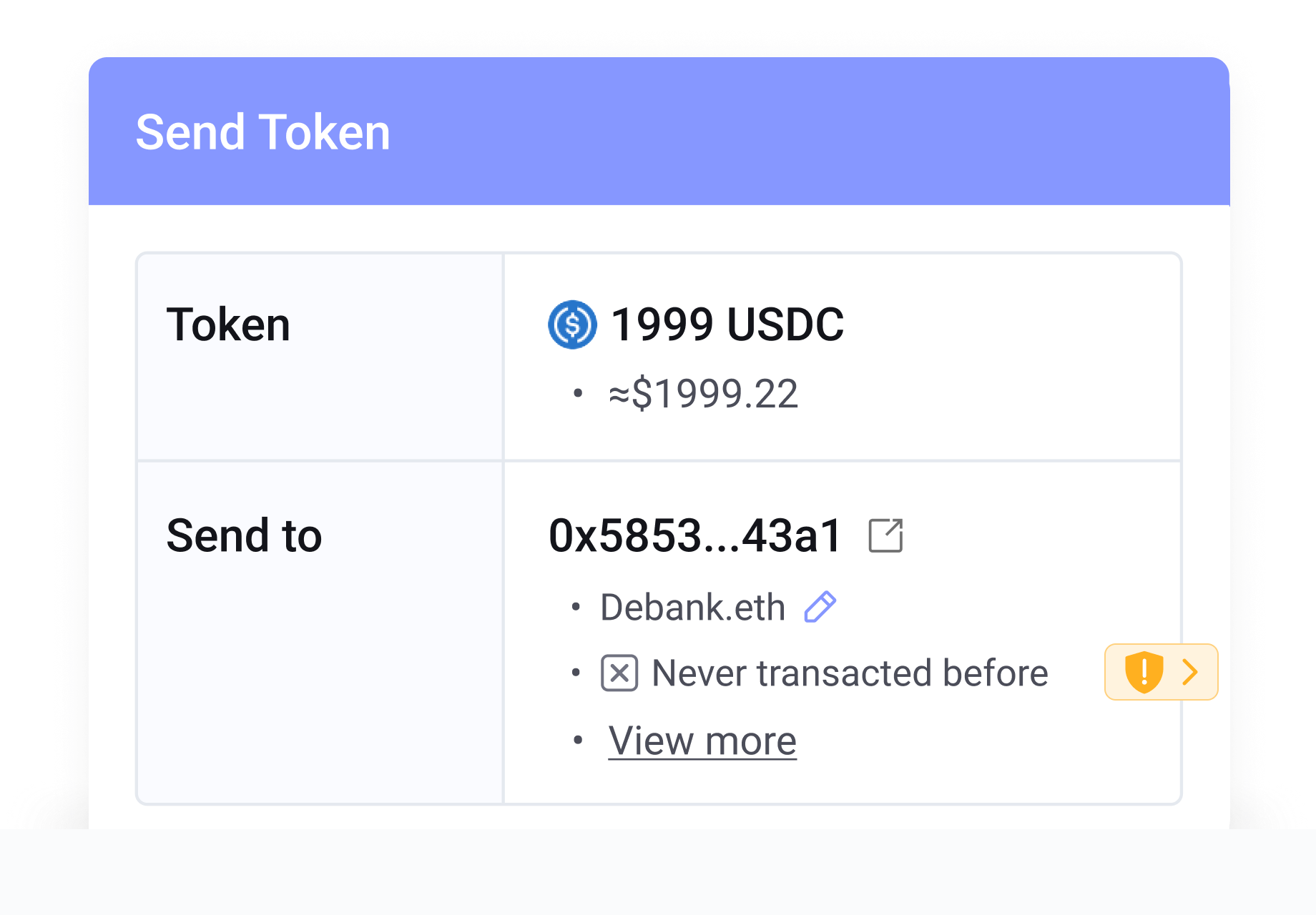
Mechanism first: how Rabby’s transaction simulation changes the signing flow
At a technical level Rabby inserts a pre-signature analysis step into the standard dApp-wallet workflow. When a dApp requests a signature, Rabby does not immediately forward the raw data to your private key. Instead it executes a local or remote simulation of the intended transaction on an equivalent EVM state, then computes and displays the likely token balance deltas and explicit fee costs. In other words, rather than merely showing the ABI-decoded call data or a raw hex blob, Rabby reconstructs the state change outcome and presents it in human-readable financial terms.
The advantage is structural: many exploits and phishing attempts rely on “blind signing,” where a user signs a message without understanding downstream balance changes or hidden calls. Simulation surfaces these downstream effects—token transfers, internal operations, reentrancy-like patterns that would otherwise be opaque—and lets users refuse signatures that would move unexpected assets. This is not just a nicer UI; it turns an opaque cryptographic approval into an economic preview.
Important nuance: simulation is only as good as the state snapshot and the models used. It depends on accurate node RPC responses, correct decoding of contract ABIs, and being able to reproduce on-chain conditions. Fast-moving MEV activity or race conditions can produce a different final outcome than the simulation predicted. So simulation reduces but does not eliminate all risk; it changes the failure modes from “I didn’t see the transfer” to “the simulation diverged from execution due to timing or oracle variance.”
Complementary protections: what Rabby does beyond simulation
Rabby combines simulation with several practical guardrails that together form a layered defense: pre-transaction risk scanning (flags hacked or suspicious contracts), built-in approval revocation (so you can cancel approvals later), automatic network switching (reduces human error when interacting with cross-chain dApps), and a gas top-up feature for cross-chain usability. Each piece addresses a common operational weak point for active DeFi traders.
Hardware wallet integration is explicit and broad: Rabby supports Ledger, Trezor, Keystone, CoolWallet, GridPlus, and BitBox02. Here the trade-off is instructive: a hardware wallet secures the private key from the host environment, whereas simulation secures the signing decision. Use both when possible—hardware for key custody and Rabby’s simulation for semantic verification of what that key will do. Even so, remember: a compromised host can still manipulate what you see on-screen. The combination reduces risk multiplicatively rather than eliminating it.
Where Rabby wins against common alternatives—and where it doesn’t
Compared to mainstream EVM wallets (MetaMask, Trust Wallet, Coinbase Wallet), Rabby’s distinguishing mechanism is explicit: simulation and pre-sign risk scanning are built into the UX rather than relying on add-ons or external services. That matters for power users who regularly interact with new contracts, DEX aggregators, and composable strategies across many chains. Automatic network switching reduces slips that cause failed transactions or accidental approvals on the wrong chain.
But there are clear limitations. Rabby lacks a built-in fiat on-ramp—so for U.S. users who want to buy crypto with a debit card inside the wallet, Rabby will not replace an exchange or a custodial on-ramp. It also does not provide native in-wallet staking, so users seeking one-stop management for staking positions must use external platforms or the chain’s own staking interfaces. These are functional gaps, not safety failures; they affect convenience, not the underlying security model.
Trade-offs and failure modes you need to understand
Three trade-offs matter when evaluating Rabby for an institutional or advanced retail workflow:
1) Simulation vs. real-time variance: simulations assume an execution context. When markets are volatile or when front-running/MEV bots are active, the final transaction outcome may differ materially from the simulation. Rabby reduces false negatives (you sign something with hidden token flows) but cannot guarantee exactness in adversarial on-chain conditions.
2) UX guardrails vs. user complacency: because Rabby surfaces security signals and lets users revoke approvals, it can create a sense of safety that leads to riskier behavior—“I’ll approve this because I can revoke later.” Revocation is helpful post-factum but not a substitute for cautious signing policy. Build rules: never sign approvals granting unlimited allowance to untrusted contracts, and use limited allowances where feasible.
3) Centralized dependencies vs. open-source inspection: Rabby is open-source under MIT license, which invites audits and transparency. But some operational elements (e.g., nodes used for simulation, third-party scanners) create centralized points of failure that could be targeted or coerced. Open-source code is a strong signal, not a panacea; audit frequency, response procedures, and infrastructure diversity matter.
Practical heuristics for using the Rabby Chrome extension
These are decision-useful rules of thumb I use and recommend to advanced DeFi practitioners in the U.S. context:
– Always pair Rabby with a hardware wallet for high-value accounts. Use Rabby’s simulation as a semantic check—what will actually move—before approving the hardware-signed transaction.
– Treat approvals as time-limited operational decisions. When interacting with new or unaudited dApps, set token allowances to the minimum necessary and revoke them after the operation via Rabby’s revocation tool.
– Use the cross-chain gas top-up selectively. It’s convenient for bridging workflows, but top-ups increase the attack surface if done without confirming destination chain contracts and addresses.
– Keep at least one “cold” multisig or institutional account (Gnosis Safe, Fireblocks) for treasury-level assets; use Rabby for active trading and composability that requires single-signature speed.
Past incidents and what they teach us
Rabby’s history includes a notable incident (a 2022 exploit in Rabby Swap that cost roughly $190,000). The team froze the contract, compensated users, and accelerated audits. This episode illustrates two points: first, no tool is immune to smart contract risk; second, the operational response—quick containment and remediation—matters as much as preventive design. For users, the takeaway is to distinguish platform-level failures (contract bugs in integrated dApps) from wallet-level compromises (leaked keys). Rabby’s simulation helps spot dangerous transactions, but it cannot fix an exploited third-party contract in real time.
FAQ
Q: Can Rabby’s simulation prevent phishing sites from stealing my funds?
A: Partially. Rabby’s pre-transaction risk scanning can flag suspicious contracts and non-existent recipient addresses and may warn of previously hacked contracts. That reduces the risk of signing a malicious transaction. However, phishing can occur through social engineering or by convincing you to approve harmless-looking operations that later enable withdrawal. Simulation helps by showing the economic effect immediately, but it cannot stop every social-engineered approval—user vigilance remains essential.
Q: If I use a hardware wallet with Rabby, do I still need the extension?
A: Yes—hardware devices secure private keys, but they don’t interpret contract logic or simulate outcomes. Rabby’s extension adds the semantic layer (what the transaction will do) before you physically approve on the device. Combining both is a best-practice: hardware for custody, Rabby for contextual signing decisions.
Q: Is Rabby a good replacement for MetaMask?
A: It depends on priorities. For power users who prioritize pre-sign simulation, approval revocation, and automatic network switching across 90+ EVM chains, Rabby is compelling. MetaMask has wider brand ubiquity and certain integrations, but lacks built-in simulation as a core UX feature. Many users use Rabby and MetaMask interchangeably (Rabby offers a Flip toggle), choosing the tool that fits the task.
Q: What should U.S. users watch next about Rabby?
A: Track three signals: (1) advancements in simulation fidelity—improvements in handling MEV or oracle variance will materially change how trustworthy previews are; (2) integrations with institutional custody and multisig (Rabby already supports Gnosis Safe and Fireblocks), which indicate maturation for higher-value flows; (3) any regulatory shifts around wallet providers and KYC obligations, which could affect integrations with fiat on-ramps or hosted services. These signals will determine whether Rabby stays primarily a DeFi-native UX tool or moves toward regulated custody partnerships.
Final synthesis: when Rabby is the right tool and when to add layers
Rabby’s Chrome extension reframes a central problem in DeFi: signing is both a cryptographic and an economic decision. Simulation translates cryptographic requests into economic previews; revocation tools and scanning add remediation and detection layers. For active DeFi users in the U.S., Rabby is particularly useful as the “semantic gatekeeper” that sits between dApps and your key. But it is not a silver bullet—simulation limitation, dependence on RPC state, and past contract-level exploits show the boundary conditions.
Practical decision framework: use Rabby for rapid, multi-chain interactions and composable strategies; always pair with a hardware wallet for high-value keys; keep a multisig cold reserve for treasury assets; apply least-privilege allowances and revoke aggressively. If you follow that stack, Rabby materially reduces common loss vectors while preserving the composability that DeFi power users value.
To learn more about installation, supported devices, and the specific UX of the browser extension, see the project page for rabby.
